
India passes bill targeting transgender community
The world's most populated country just passed a bill that effectively undermines self-identification rights for its transgender community.

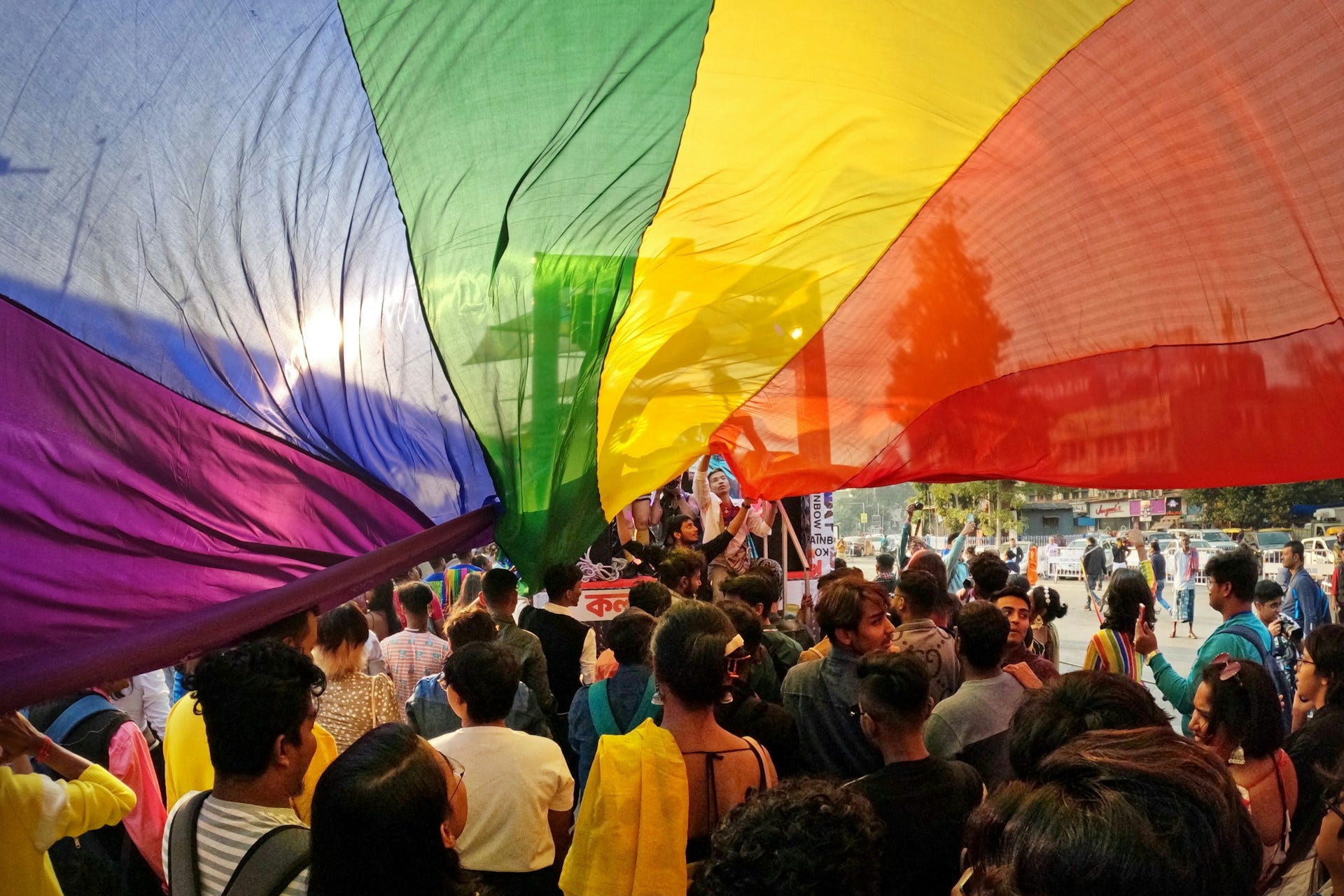
On Tuesday, March 24, Indian Parliament passed the Transgender Persons (Protection of Rights) Amendment Bill despite heavy criticism from the country’s LGBTQ+ activists. An amendment to the 2019 law, the new bill removes a provision that allowed transgender individuals to obtain legal recognition based on their self-declared identity.
The law now requires trans individuals to undergo a medical check and be granted a doctor’s approval for district authorities to issue identity documents. In doing so, the bill erroneously conflates biological attributes with gender identity, forcing transgender people to undergo sex-reassignment surgery to legally identify as their gender.
The amended bill completely wipes out legal definitions of trans man or woman, non-binary, and genderqueer, which were formally defined in the 2019 law. The only definitions it retains are related to third gender identities rooted in South Asian Hindu culture — such as kinner, hijra, aravani, and jogta — and intersex, which falls under biological attributes rather than gender identity.
The amendment had faced heavy criticism from India’s LGBTQ+ civil society, who denounced a significant rollback in the fight for queer rights in the country, while also raising concerns with regards to the safety, privacy, and dignity of transgender people.
The right to self-identification has long been at the forefront of queer activism in India, and the Supreme Court had previously ruled in favour of this right, most notably in 2014, widely considered a watershed moment for the legal recognition of transgender Indians.
2014 also marked the rise of Narendra Modi, and the Bharatiya Janata Party (BJP) to the office of Prime Minister. Widely considered right-wing, with many analysts even describing it as far-right, the BJP has garnered public support embracing Hindutva, a nationalist ideology inspired by European fascism that promotes Hindu hegemony in India. Hindutva policies mesh Indian and Hindu identities together, actively promoting Hindi and Hinduism as the sole legitimate language and religion of India respectively.
The BJP has been reported to stir up nationalist sentiment among India’s Hindu majority against linguistic and religious minorities across the country, particularly Indian Muslims. Modi himself is seen as a key figure driving nationalist and Islamophobic extremism in the country. He is most notoriously considered to have instigated anti-Muslim pogroms during his time as Chief of Minister of the state of Gujarat in 2002.
Since being first elected Prime Minister 12 years ago, Modi’s policies have propelled Hindutva into the mainstream of Indian politics, including abrogating the special status of Jammu and Kashmir, the Ayodhya land dispute, and forced conversion bans targeting Muslims in several BJP-ruled states.
While Hindutva primarily targets linguistic and religious minorities, LGBTQ+ issues have at times been in the discussion, mainly framing them as part of the Hindu nationalist project. Some BJP politicians and other Hindutva advocates have previously expressed support for the legal recognition of same-sex relationships, citing the native Hindu culture & history as welcoming of homosexuality. Though it claims to support for recognizing same-sex relations, the BJP’s position opposes any form of civil union.
With growing Hindu extremism only focusing on queer issues as part of its nationalist project, it seems rather unsurprising that BJP would eventually seek to restrict legal spaces for transgender Indians to exist freely. This feels especially relevant at a time when transgender people across the world have become a main target of rising conservatism.
The amended bill’s safeguarding of South Asian third gender identities, rooted in ancient Hindu practices, while removing definitions for trans men and women, similarly fits into the BJP’s nationalist agenda supporting sexual and gender minorities only when it’s able to frame it as part of Hindutva. Much like Israel’s pinkwashing efforts to legitimize and get global support for its genocide in Palestine, this kind of nationalist approach to queerness isn’t rooted in the will to protect and empower queer people. Their queerness is merely a vehicle for supremacist nation-building.
The timing of the Trans Amendment Bill undoubtedly reflects a global shift rightwards when it comes to queer rights. For queer activists in India, it also represents a considerable backsliding, both in the scope of the rights it effectively strips transgender people of, and the speed at which it was passed, less than two weeks after being introduced in Parliament.
For a country like India, once considered the “world’s largest democracy,” the passing of such a bill with such haste and little effort to consult with the community it targets also signals backsliding into soft authoritarianism, one of many such incidents under Modi.
In an online statement, the National Council of Transgender Persons (NCTP) called out the Ministry of Social Justice and Empowerment (MoSJE) for only consulting them after the bill had been drafted. They denounced the stubbornness and hostile attitudes of ministry officials, many of whom did not show up to the meeting with NCTP activists, who were called at midnight on Monday, March 23, to meet with MoSJE the same day.
Beyond stripping transgender individuals of their right to self-identify, the bill also minimizes punishment for sexually assaulting transgender women as opposed to cisgender women, allegedly citing “anatomical differences.”
Furthemore, MoSJE reportedly rejected activists’ suggestions on safety systems for transgender youths experiencing family abuse from transphobic parents. Transgender activist and author Kalki Subramaniam, who attended the meeting with NCTP, even said that the ministry responded by accusing transgender people who are believed to “lure” or “brainwash” underaged individuals away from their families.
The terminology surrounding not only the actual amendment to the bill, but also politicians’ framing of the issue and attitude towards the local transgender community echoes the rise of transphobia worldwide. The pitting of transgender individuals, particularly transgender women, against cisgender women has gained prominence in the mainstream, with the likes of former author J.K. Rowling and disgraced swimmer Riley Gaines leading the anti-trans hate campaign.
MoSJE’s reliance on “anatomical differences” to justify lesser punishment for sexual assaulting transgender women parallels the growing use of “biological women” that Rowling, Gaines, and many other trans-exclusive radical feminists (TERFs) have employed to defend transphobia under the guise of feminism. Oftentimes, this form of so-called feminism is less so predicated upon pushing for women’s rights than it is about explicitly depriving transgender people from their rights, even if doing so also results in women’s rights being taken away.
Conservative discourse claiming that queer people are “luring”, “brainwashing,” or otherwise attempting to corrupt the youths has also been at the forefront of the ‘culture war’ pitting progressive ideology against right-wing conservatism in the US.
Over the past decade or so, there have also been many attempts from American conservative Christian groups, particularly evangelical Christians, to export this culture war abroad through the funding of faith-based groups in developing countries. Majority Christian countries in Latin America and Africa, as well as some Christian groups in Asia, have been emboldened by U.S. evangelicals to enact legislation prohibiting same-sex relationships and unions, even going as far as enforcing death penalty as a punishment in some cases.
Anti-LGBTQ+ legislation is often accompanied by a shift in mainstream discourse on queer people mirroring the language and main talking points of the US alt-right. Such examples have been observed in countries such as Uganda and Singapore, and has even gained traction in places where Christians only exist in minority, like Malaysia and Kenya.
Read more:

The normalization of anti-trans rhetoric and legislation also hints at a slippery slope that is likely to target gays and lesbians next. For countries like India, where consensual same-sex sexual activities between men were only decriminalized in 2018, and same-sex relationships still lack legal recognition, the aftershock is likely to just as hard as it hit the community’s transgender allies, if not stronger.
Conservative groups in the West have increasingly relied on ‘divide and conquer’ tactics to crack down on transgender communities, isolating them from the rest of the LGBTQ+ spectrum and resulting in sexual minorities turning against gender minorities — the LGB Alliance is one such example.
However, evidence from rising conservatism in the US shows that conservative support for these groups is short-lived. Legislation that is nominally passed against transgender people ends up being used as blueprint for similar laws and policies that end up targeting the community as a whole, whether they seek to criminalize drag, Pride flags, or Diversity, Equiy, and Inclusion efforts. In short: there is no envisioning unequivocal queer liberation without combating growing anti-trans rhetoric and legislation across the world.
For countries in Southeast Asia, where legal recognition and protection of queer minorities is at best lacking and at worst prohibited, the case of India provides a grim example of how quickly LGBTQ+ discriminatory legislation can pass, and the need for a united advocacy front across queer groups. At the same time, this new bill also shows how certain queer identities can be co-opted by hegemonic forces to push a nationalist agenda while disenfranchising other segments of the queer population.